Synthetic Biology
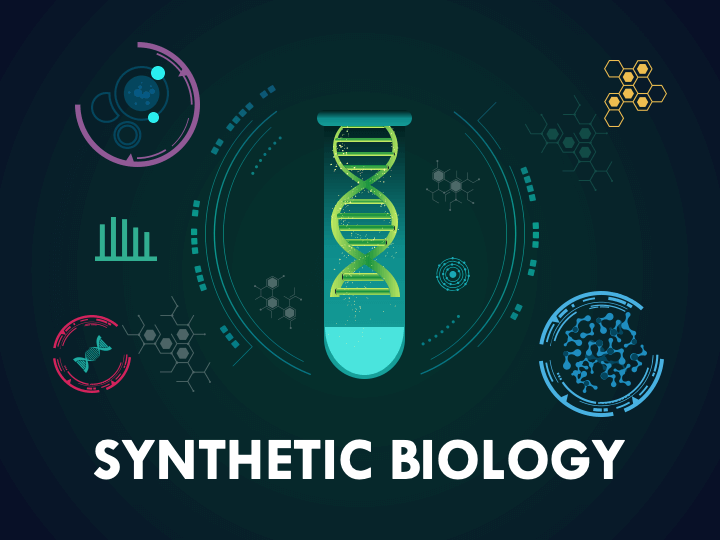
Synthetic biology is a multidisciplinary field that applies engineering principles to design and construct new biological components or redesign existing natural components towards applications.
Synthetic Biology
WHAT IS SYNTHETIC BIOLOGY
The term “Synthetic Biology” was formally proposed in the first meeting of Synthetic Biology at MIT in June 2004. This primordial event discussing the role of standards and constructions in biology received a massive press coverage and triggered a new wave of thinking and excitement in the community. Using natural and lab-made parts one could construct new designs or replicate natural designs. Interestingly, the terms “synthetic biology” and “Biological engineering” are used interchangeably to indicate the science of construction in biology.
Over the last decade and a half, the term ‘synthetic biology’ has been enriched with distinct variants. For example, a chemical engineer may consider synthetic biology as an approach to design novel controls on metabolic pathways for a more predictable output. A metabolic engineer may want to install novel metabolic pathways or transfer chunks from other organisms using the new ‘synthetic biology’ terminology. A molecular biologist may build biological standards, rules of composition, long DNA synthesis and genome editing technologies under ‘synthetic biology’. For an organic chemist, it may be about synthesis of chemicals and biochemicals using microbial factories or creating a functional non-ATGC DNA. For a systems biologist, synthetic biology may be about finding how cells organize massively parallel and massively interactive processes and use the nature’s designs to construct novel and stable networks. The beauty of synthetic biology is that it leaves ample scope of innovation from parts to organisms.
The Centre for Biodiversity lists several key definitions of synthetic biology in its 2015 report.
Synthetic biology aims to design and engineer biologically based parts, novel devices and systems – as well as redesigning existing, natural biological systems.’’ (Kitney and Freemont 2012)
Synthetic biology aims to design and engineer biologically based parts, novel devices and Engineering systems as well as redesigning existing, natural biological systems (UK Royal Academy of Engineering, 2009)
Synthetic biology attempts to bring a predictive engineering approach to genetic engineering using genetic ‘parts’ that are thought to be well characterized and whose behavior can be rationally predicted. (International Civil Society Working Group on Synthetic Biology 2011)
Synthetic biology … combines elements
of biology, engineering, genetics, chemistry, and computer science. The diverse but related endeavors … rely on chemically synthesized DNA, along with standardized and automatable processes, to create new biochemical systems or organisms with novel or enhanced characteristics. (US Presidential Commission for the study of Bioethical issues 2010)
What makes synthetic biology unique and distinct from other disciplines?
Synthetic biology aspires to engineer living systems through rational design and construction. While genome-wide data on biological parts, devices, and circuits is accumulating, the fundamental rules governing organismal composition remain elusive. Unlike established engineering fields with standardized components and design principles (such as the IEEE in electronics), synthetic biology lacks equivalent standards. To address this, researchers envision a future where biological pathways can be installed like plug-in apps, facilitated by advancements in long DNA synthesis, genome editing tools, and the development of biofoundries. Moreover, the exploration of non-ATGC DNA base pairs could expand the genetic alphabet and potentially lead to novel biological systems.
Reg No: EKM/TC/667/2023 | Registered under The Travancore-Cochin Literary Scientific and Charitable Societies Registration Act 1955
Quick Contact
Interested in collaborating, learning more, or joining the biorevolution? Contact us today!
Centre for Synthetic Biology and Biomanufacturing, CUSAT Technology Business Incubator, 3rd Floor, CUSAT-Students' Amenity Centre, Cochin University of Science and Technology, Kalamassery, Kochi 682 022